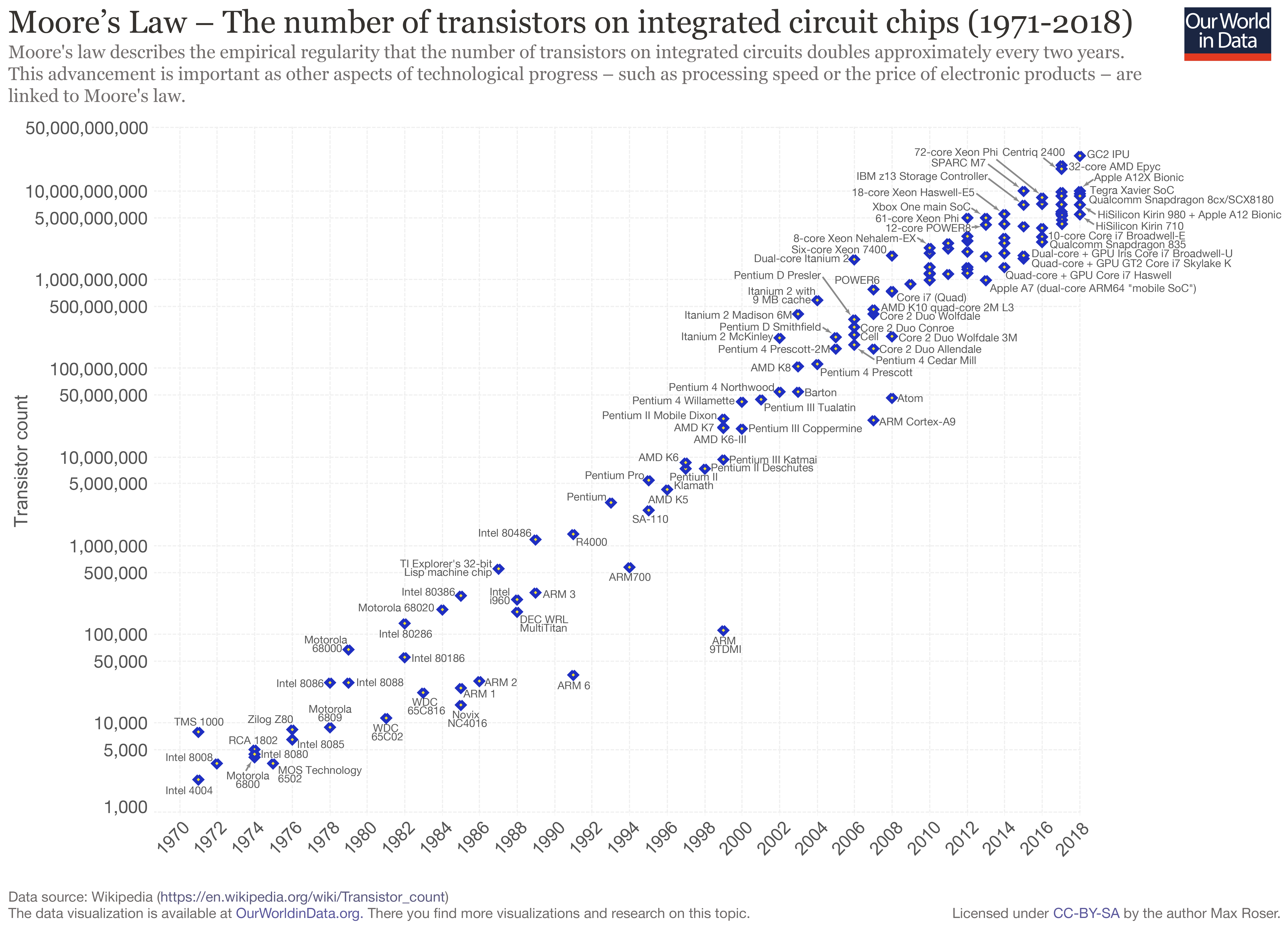
Moore's Law
Moore's Law was proposed in 1965 as an observation by Gordon Moore5, then employed by Fairchild Semiconductor. Initially, Moore estimated that the number of components in an integration circuit would double every year. He later changed his estimate to every two years. In practice, the doubling has occurred roughly every 18 months10, as shown in the graph to the right.
Today, some engineers, including the CEO of the NVidia corporation, are predicting that the progress predicted by Moore's Law must soon come to an end11. The current incredibly small size of transistors has begun to come up against the laws of physics, which results in electrons moving unexpectedly to places they should not be. Denser circuits also produce more heat and consume more power, which is why current processors increasingly add cores rather than more components.
If Moore's Law does begin to falter, it will fall to software engineers to write more efficient software to leverage existing power more effectively, rather that rely on always getting more processing power year after year11. As software engineers, this presents an interesting challenge as we move forward in the industry. Increasing software efficiency is a like solving a puzzle. All the pieces of any particular piece of software must be rearranged and optimized in ways the original author had probably not considered.