Gordon Moore was born in San Francisco in 19292. As a child, Moore became interested in chemistry3 , eventually going on to earn a doctorate in physical chemistery At the California Institute of Technology3. After earning his PhD, Moore's first job at Shockley Semiconductor was a disappointment to him3 and after a short time, he and some colleagues - who were called the "traitorous eight" at the time4 - left to found Fairchild Semiconductor in 19573. In 1965, while still at Fairchild, that Moore postulated what later came to be called Moore's law5. Three years later, he left Fairchild and helped found the Intel Corporation6. Moore retired from the Intel corporation in 20013.

The Intel Corporation was founded in 1968 by Robert Noyce and Gordon Moore7. Initially, Intel produced memory chips. They started with the relatively unsuccessful but revolutionary 1101, and followed that with the vastly more successful 1-kilobyte DRAM chip, the 11037. Over the years, Intel's product met with mixed success. It was in 1978 that Intel's true ascendancy began. That year, Intel released the 16-bit 8086 processor, the ancestor of the later Pentium series and today's Core series of processors7. With the 8086 processor came the x86 instruction set which has been extended and built on for 40 years and is still used today8.
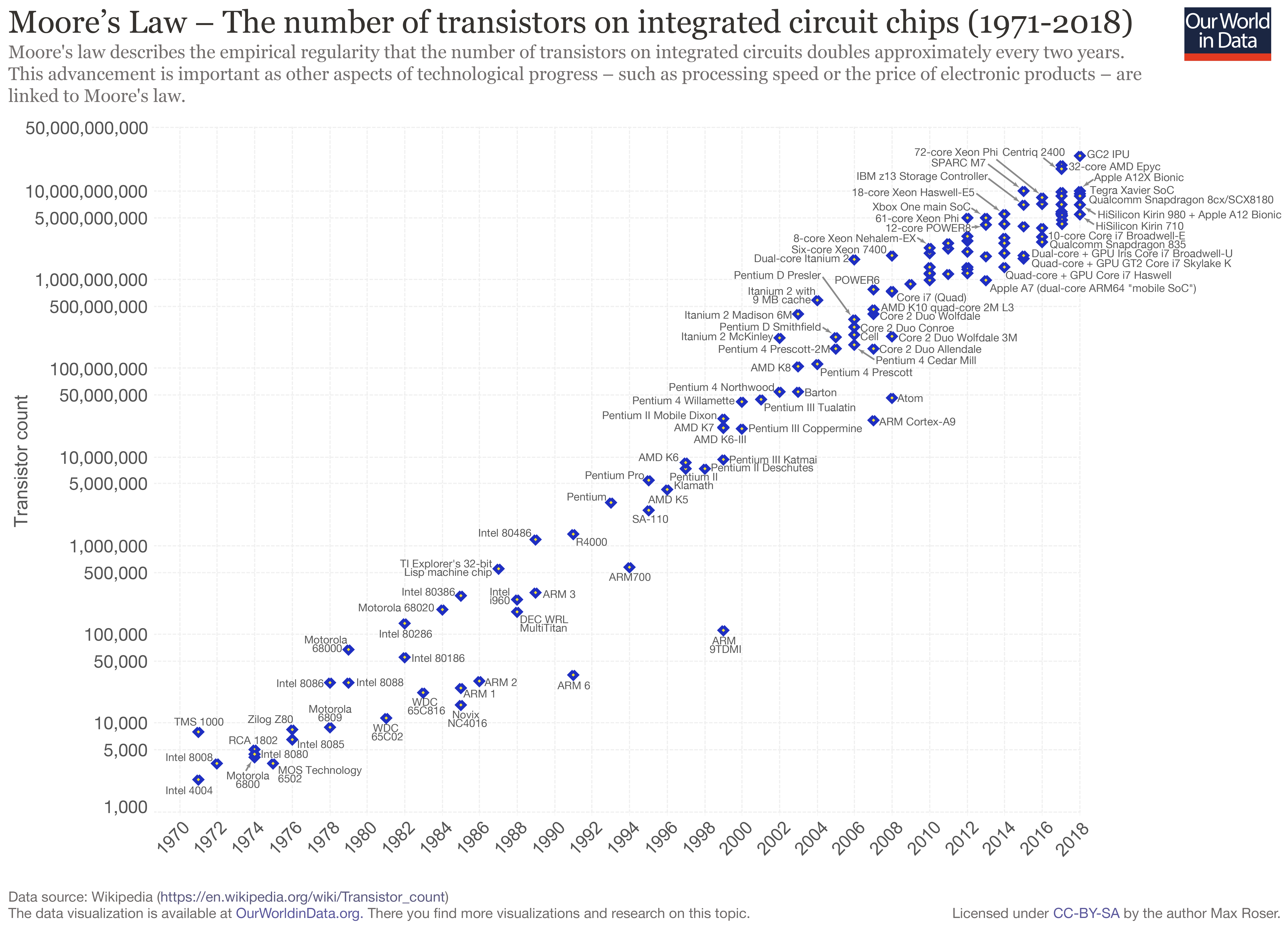
As mentioned above, Moore's law was put forth in 1965 by Gordon Moore. Originally, Moore estimated that the density of components in an integrated circuit would double every year. He adjusted his prediction in 1975 to every two years9. As can be seen in the graph to the right, this prediction has been roughly correct for the last 40+ years.